Idempotent Data Pipelines: Making Re-runs Boring
Retries and backfills are inevitable. Design pipelines so that running them twice gives exactly the same result as running them once.
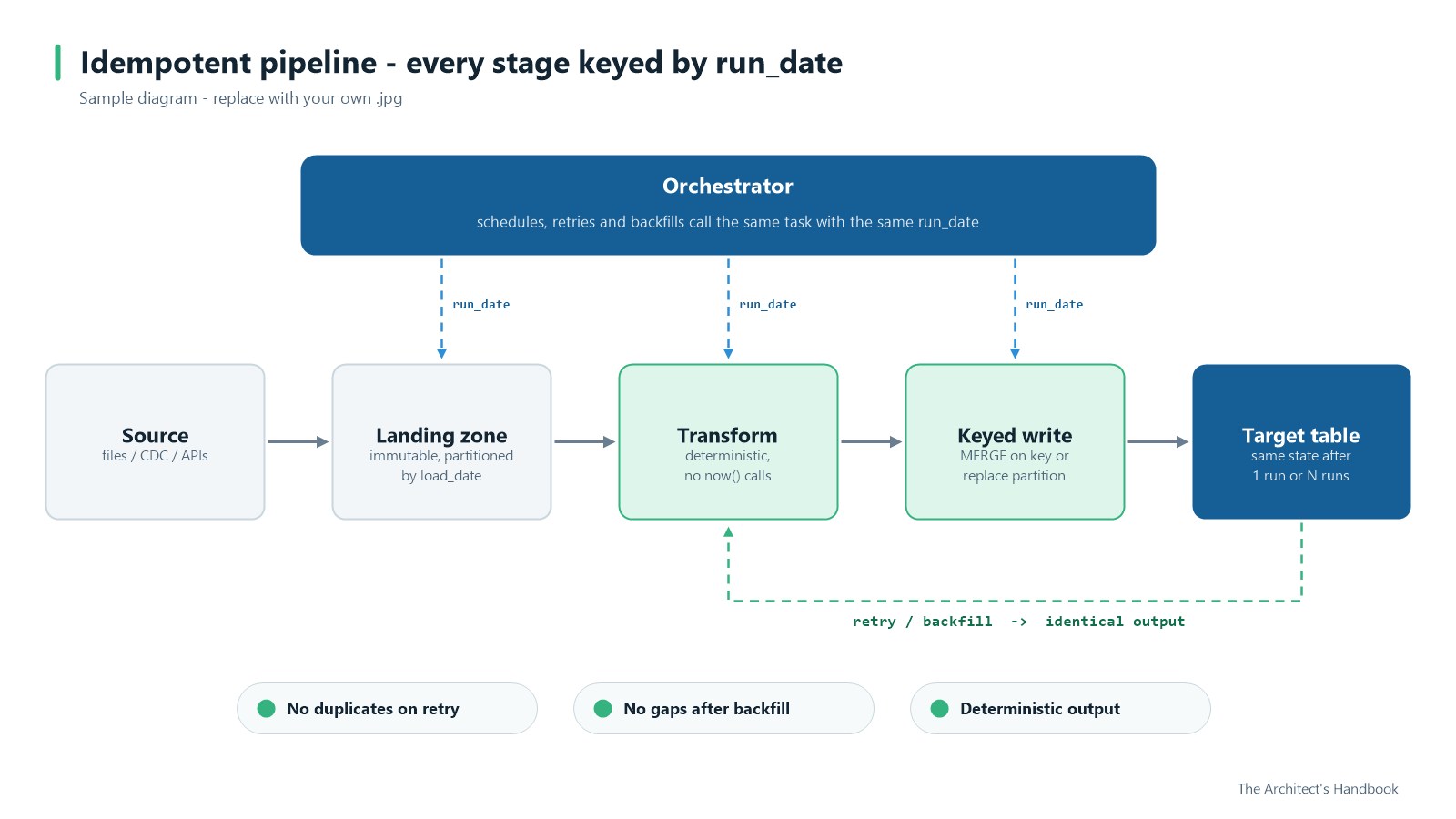
Every pipeline will be re-run: a node dies, an upstream file arrives late, a bug fix needs a backfill. An idempotent pipeline produces the same output no matter how many times a run is repeated — which turns those incidents from data-quality emergencies into non-events.
What idempotency means for data
A task is idempotent when run(x) followed by run(x) leaves the target in
exactly the same state as a single run(x). For data pipelines that implies:
- No duplicates when a run is retried.
- No gaps when a run is skipped and later backfilled.
- Deterministic output for a given input and run parameter.
Pattern 1 — replace a whole partition
When each run owns a well-defined slice of data (usually a date), overwrite that slice atomically instead of appending to it:
(
    daily_events
    .write
    .format("delta")
    .mode("overwrite")
    .option("replaceWhere", f"event_date = '{run_date}'")
    .saveAsTable("silver.events")
)
Running this twice for the same run_date replaces the partition twice —
the end state is identical.
Pattern 2 — merge on a natural key
For entity tables that receive updates, upsert on a business key and only apply a change if it is newer than what is already stored:
MERGE INTO silver.customers AS t
USING staged_customers AS s
  ON t.customer_id = s.customer_id
WHEN MATCHED AND s.updated_at > t.updated_at THEN
  UPDATE SET *
WHEN NOT MATCHED THEN
  INSERT *;
UPDATE SET */INSERT *is Delta Lake syntax. Other engines need explicit column lists, but the pattern is identical.
Pattern 3 — derive time from the run, not the clock
current_date() inside a transformation makes the output depend on when the
job ran. Pass the logical run date from the orchestrator instead, and use it
everywhere: in filters, partition values and output paths.
| Pattern | Use when | Watch out for |
|---|---|---|
| Partition overwrite | Each run owns a time slice | Late data landing in older partitions |
| Merge on key | Entities are updated over time | Missing or unstable business keys |
| Run-date parameter | Always | Hidden now() calls in UDFs and views |
Wrapping up
Idempotency is cheap to design in and expensive to retrofit. Pick a write pattern per table, parameterise everything by the logical run date, and retries become the most boring part of your on-call rotation.
Comments
Questions, corrections and war stories welcome. New comments appear after a quick review.
Loading comments…