Anatomy of a Production RAG System
Retrieval-augmented generation is easy to demo and hard to run. A walkthrough of the offline indexing path, the online query path and the evaluation loop that ties them together.
A retrieval-augmented generation (RAG) prototype fits in fifty lines of code. A production RAG system is a data platform with an LLM at the end of it — and most of its failures are data failures, not model failures.
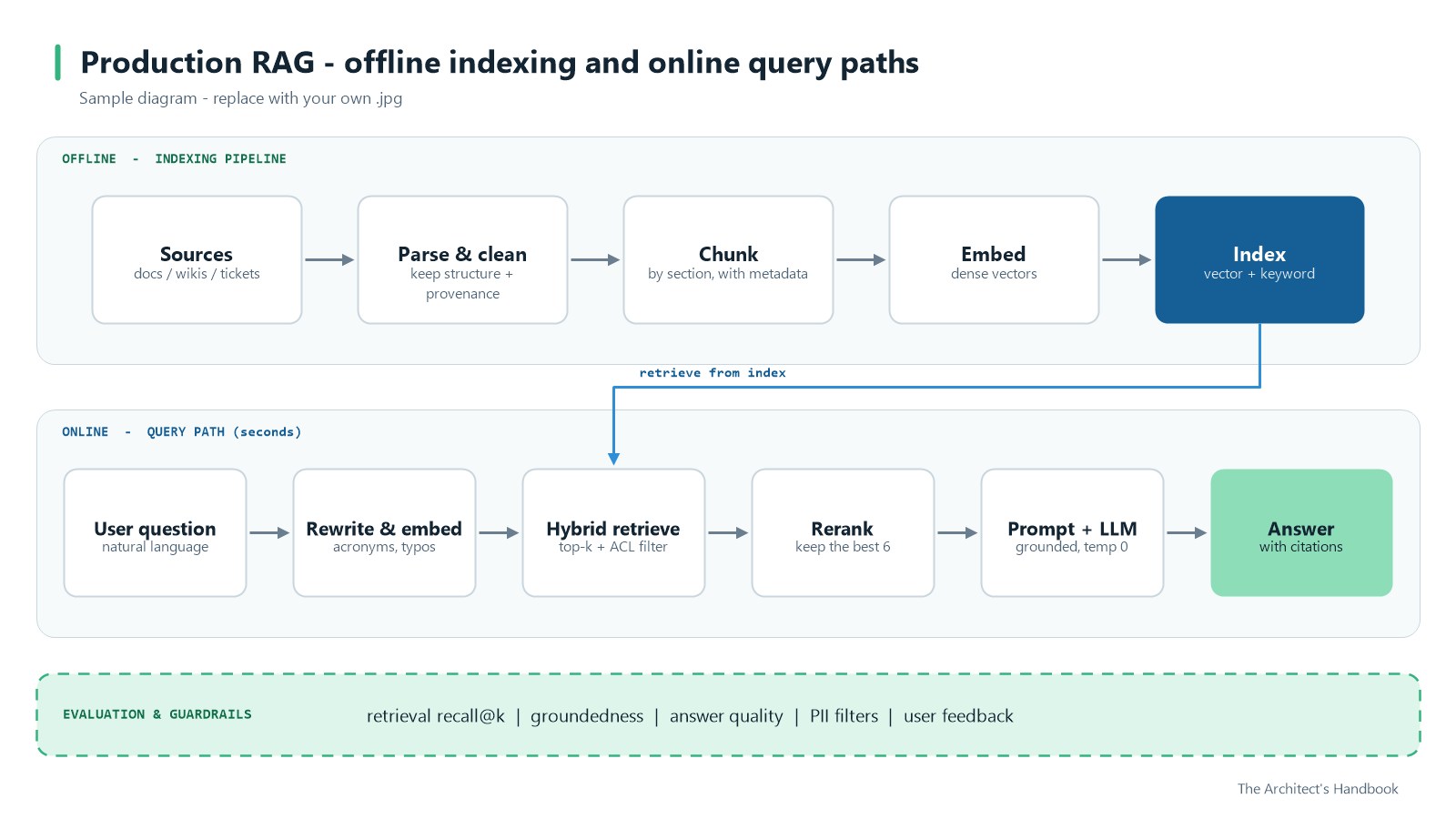
Two paths, one index
Every RAG system has two halves that run on very different schedules:
- Offline indexing turns source documents into searchable chunks. It is a batch or streaming data pipeline and should be engineered like one.
- Online querying turns a user question into a grounded answer within a latency budget, typically a few seconds end to end.
The offline path
Parse and clean
PDFs, wikis and tickets all need different parsers. Strip navigation chrome, keep headings and tables, and record where every piece of text came from — you will need that provenance for citations.
Chunk with structure
Fixed-size chunks are a fine baseline, but chunking along document structure (sections, list items, table rows) usually retrieves better. Store metadata such as title, section path, timestamp and access-control labels with every chunk.
Embed and index
Index each chunk twice: as a dense vector for semantic similarity, and as text for keyword search. Hybrid retrieval rescues the queries that embeddings handle poorly — product codes, error messages and acronyms.
The online path
def answer(question: str) -> Answer:
    query = rewrite(question)                       # expand acronyms, fix typos
    candidates = index.hybrid_search(
        query, top_k=40, filters=user_acl_filter()  # never retrieve what the user can't see
    )
    passages = reranker.rerank(question, candidates)[:6]
    prompt = build_prompt(question, passages)
    response = llm.generate(prompt, temperature=0)
    return Answer(text=response.text, citations=[p.source for p in passages])
Apply access-control filters at retrieval time. Filtering the final answer is too late — the model has already seen the restricted text.
Evaluate retrieval and generation separately
When an answer is wrong, you need to know whether the right passage was never retrieved or was retrieved and then ignored.
| Failure mode | Symptom | Typical fix |
|---|---|---|
| Retrieval miss | Correct passage not in the top k | Better chunking, hybrid search, rewrite |
| Ranking miss | Passage retrieved but ranked too low | Add or tune a reranker |
| Grounding failure | Answer contradicts the retrieved passages | Stricter prompt, citations, lower temp. |
| Stale knowledge | Answer reflects an outdated document | Incremental re-indexing, freshness score |
Build a small “golden set” of 50–100 real questions with known source passages before tuning anything. Without it, every change is a guess.
Wrapping up
Treat the index as a data product with owners, freshness SLAs and quality checks, and treat the LLM as one component of a pipeline you can measure. Do that, and RAG stops being a demo and starts being a system.
Comments
Questions, corrections and war stories welcome. New comments appear after a quick review.
Loading comments…