Designing a Lakehouse with the Medallion Architecture
How to structure raw, refined and curated layers so a lakehouse stays trustworthy, debuggable and cheap to evolve.
A lakehouse without structure turns into a swamp surprisingly quickly. The medallion architecture is a simple layering convention — bronze, silver, gold — that gives every table a clear contract and every engineer a shared vocabulary.
Why layer a lakehouse at all?
Most data problems are really trust problems. When a dashboard number looks wrong, the team needs to answer three questions quickly: what did the source actually send, what did we do to it, and which business rule produced the final figure? Layering separates those concerns so each one can be inspected on its own.
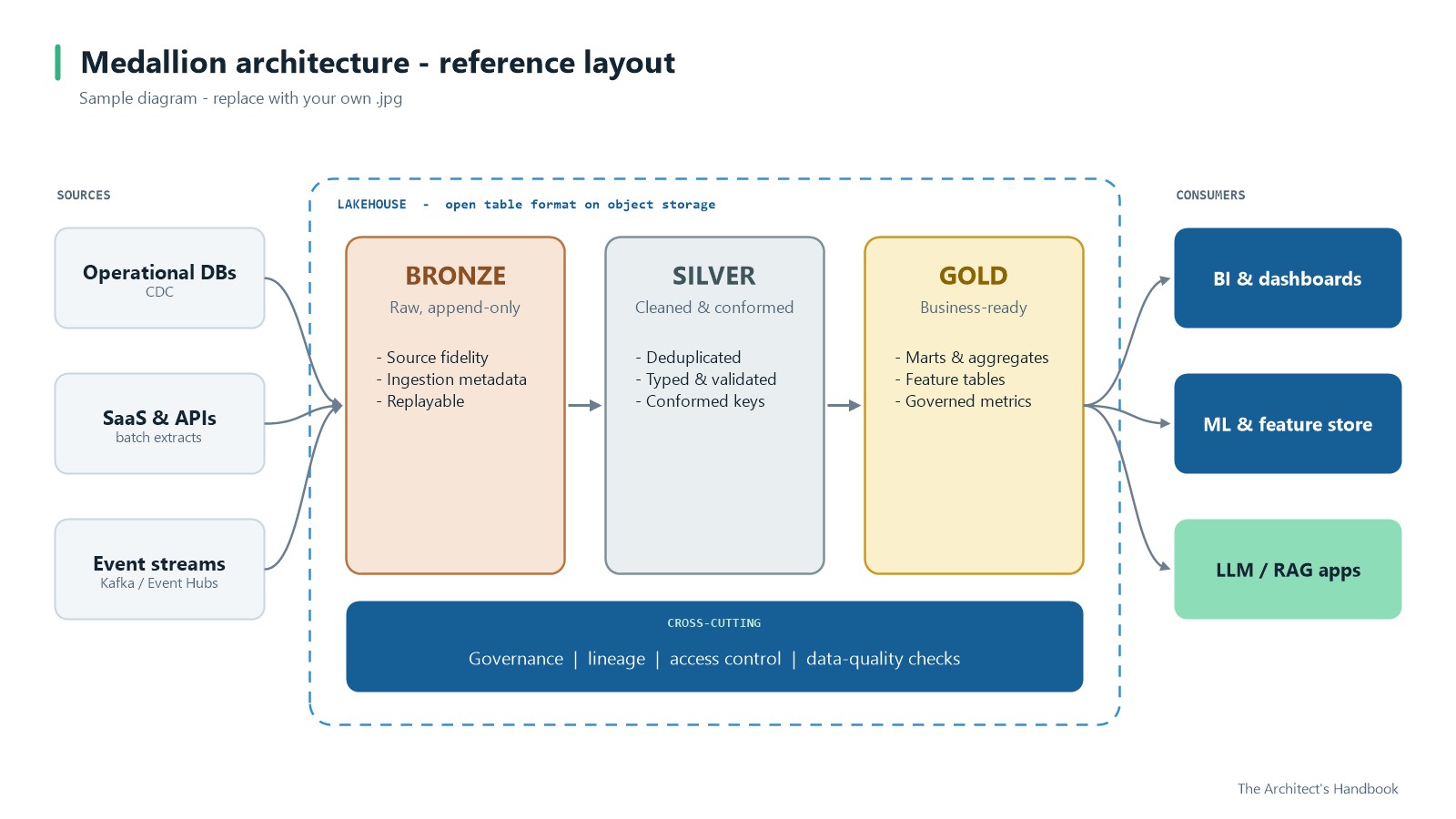
The three layers
Bronze — raw and append-only
Bronze is a faithful, replayable copy of what the source sent, plus ingestion metadata such as load time, source file and batch id. Resist the urge to clean anything here: if a transformation bug is found next quarter, bronze is what lets you rebuild everything downstream.
Silver — cleaned and conformed
Silver is where data becomes usable: types are enforced, duplicates removed, late-arriving records merged and entities conformed to shared keys. Silver tables are modelled around business entities (customers, orders, devices), not around source systems.
Gold — business-ready
Gold tables answer specific questions: aggregates, dimensional marts, feature tables and governed metrics. They are small, documented and owned by a team that can explain every column.
| Layer | Purpose | Typical operations | Main consumers |
|---|---|---|---|
| Bronze | Source fidelity, replay | Append, schema-on-read, audit columns | Data engineers |
| Silver | Clean, conformed entities | Dedupe, type, merge/upsert, join keys | Engineers, analysts, ML |
| Gold | Business answers | Aggregate, model, apply business rules | BI, applications, AI |
Keep bronze retention long and cheap (object storage is inexpensive), but keep gold small and well-documented. Most cost and confusion comes from sprawling, undocumented gold tables.
A gold table, end to end
Gold transformations should be boring, declarative SQL over silver:
CREATE OR REPLACE TABLE gold.daily_revenue AS
SELECT
  order_date,
  region,
  SUM(net_amount)              AS revenue,
  COUNT(DISTINCT customer_id)  AS customers
FROM silver.orders
WHERE status = 'COMPLETED'
GROUP BY order_date, region;
If a gold query needs to reach back into bronze, that is a signal that a silver table is missing.
Never point BI tools at bronze. Raw data changes shape without warning, and dashboards built on it become the first thing to break.
Common anti-patterns
- Source-shaped silver. Copying each source table into silver one-to-one just moves the mess one layer down.
- Business logic in bronze. Filtering or “fixing” records on ingestion destroys your ability to replay.
- Gold for everything. Not every query deserves a persisted table; views over silver are often enough.
- Non-idempotent loads. Re-running a job should never duplicate data — see Idempotent Data Pipelines.
Wrapping up
The medallion architecture is less about the names of the layers and more about the guarantees each layer gives. Write those guarantees down, enforce them with tests, and the lakehouse stays explainable as it grows.
Comments
Questions, corrections and war stories welcome. New comments appear after a quick review.
Loading comments…